Understanding minerals to improve dairy cow health
Aisling Claffey joined Stuart Childs on the Dairy Edge podcast to explain how minerals like magnesium and vitamin D support cows around calving. The discussion highlights the vital role of consistent mineral supplementation in preventing milk fever and related health issues in grazing dairy herds.
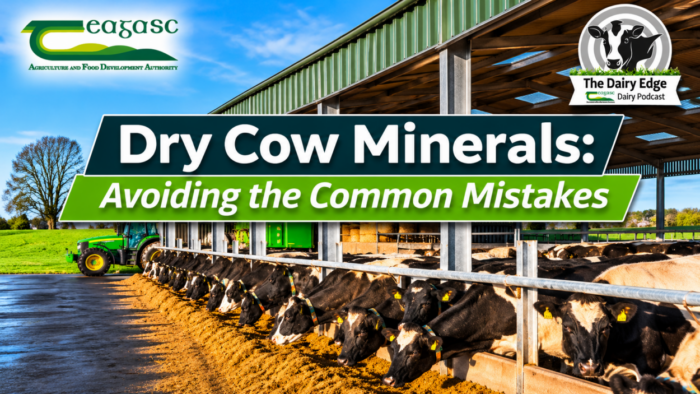
Importance of key minerals
Magnesium stands out as a crucial mineral before calving, necessary to help cows mobilise calcium effectively during this demanding period. Alongside magnesium, vitamins—especially vitamin D—play a significant part in preventing milk fever, a condition that can severely impact the health of dairy cows.
Consistency and testing
Maintaining a steady supply of minerals is essential. Even brief lapses in mineral feeding can have negative effects, particularly when many cows are approaching calving. As soil fertility improves, Aisling recommends that farmers test their silage annually for mineral content. Variations in silage potassium levels from year to year can interfere with magnesium absorption, making awareness of feed composition vital.
Wider implications of milk fever
Milk fever is not just a standalone issue; it can compromise muscle function, calving, rumen contractions, and feed intake. It is often regarded as a gateway disease, predisposing cows to further problems such as transition-cow disorders and mastitis. Preventing milk fever through consistent mineral supplementation is therefore key to maintaining herd health.
For those interested, the full discussion is available on the Dairy Edge podcast website, which hosts a range of episodes focused on dairy farming challenges and innovations.