Gurteen College rewetting project cuts peat soil emissions
A pioneering three-year rewetting initiative at Gurteen College has successfully reduced greenhouse gas emissions from drained peat soils through subtle water table management. Located in County Galway, the project—funded by the Department of Agriculture, Food and the Marine—demonstrates how modest adjustments to grazing timing and drainage control can deliver measurable climate benefits across Ireland’s 140,000 hectares of drained peat grassland.
Source:
Teagasc Agricultural News
•
⏱️ 2 min read
A quiet revolution in climate-smart farming has taken place at Gurteen College, where a carefully calibrated rewetting project on heavy peat soils significantly lowered greenhouse gas emissions over three years. Led by Senior Research Officer Patrick Tuohy, Farm Manager and Lecturer Kenneth Flynn, and Teagasc Signpost advisor Siobhan Kavanagh, the initiative formed part of the Department of Agriculture, Food and the Marine’s ReWet Project—and proved that impactful climate action need not disrupt core farm operations.
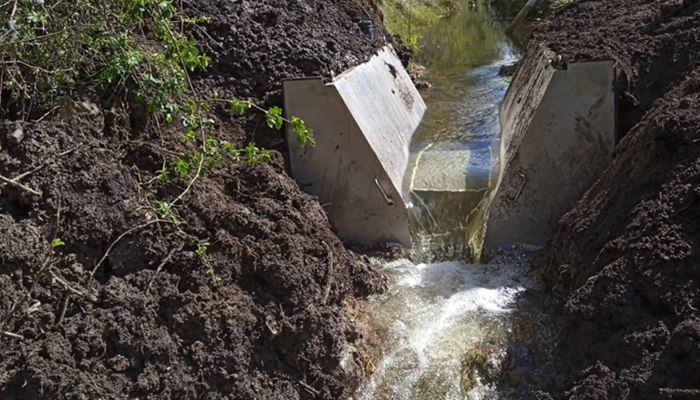
The project began in early 2023, when a shallow dam was installed in a key drain on a drystock-grazed field containing 12 inches to 6 feet of drained peat. Far from flooding the land, the structure gently slowed outflow—raising the water table by up to 30 cm in targeted areas. Monitoring revealed modest but meaningful changes: increased surface water in winter, a slightly later spring turnout, and earlier autumn housing—yet overall grazing days across the 12-field drystock unit remained unchanged. Crucially, data showed carbon storage increased by approximately one tonne per hectare per year where the water table was lifted.
This work builds on foundational conversations in 2022 between College Principal Jon Parry, Kenneth Flynn, and Teagasc researchers from Moorepark and Johnstown Castle—sparked by the installation of an Eddy covariance tower to measure net ecosystem exchange. Though initial concerns about field flooding were quickly allayed by Teagasc’s practical, farmer-centred approach, the real breakthrough was reframing ‘rewetting’ as precise water table management. With national policy now poised to scale such interventions, Flynn encourages fellow farmers to engage with available supports: small, science-informed changes, he says, can yield substantial climate dividends. Further details on the Teagasc Signpost Programme, Gurteen College, and the ReWet Project are available on the official website.
The project began in early 2023, when a shallow dam was installed in a key drain on a drystock-grazed field containing 12 inches to 6 feet of drained peat. Far from flooding the land, the structure gently slowed outflow—raising the water table by up to 30 cm in targeted areas. Monitoring revealed modest but meaningful changes: increased surface water in winter, a slightly later spring turnout, and earlier autumn housing—yet overall grazing days across the 12-field drystock unit remained unchanged. Crucially, data showed carbon storage increased by approximately one tonne per hectare per year where the water table was lifted.
This work builds on foundational conversations in 2022 between College Principal Jon Parry, Kenneth Flynn, and Teagasc researchers from Moorepark and Johnstown Castle—sparked by the installation of an Eddy covariance tower to measure net ecosystem exchange. Though initial concerns about field flooding were quickly allayed by Teagasc’s practical, farmer-centred approach, the real breakthrough was reframing ‘rewetting’ as precise water table management. With national policy now poised to scale such interventions, Flynn encourages fellow farmers to engage with available supports: small, science-informed changes, he says, can yield substantial climate dividends. Further details on the Teagasc Signpost Programme, Gurteen College, and the ReWet Project are available on the official website.