Practical steps to enhance Ireland’s water quality
A key conference will focus on improving water quality through better farm practices and compliance. Taking place in County Laois, this event gathers experts and farmers to discuss nutrient reduction and safeguarding aquatic ecosystems.
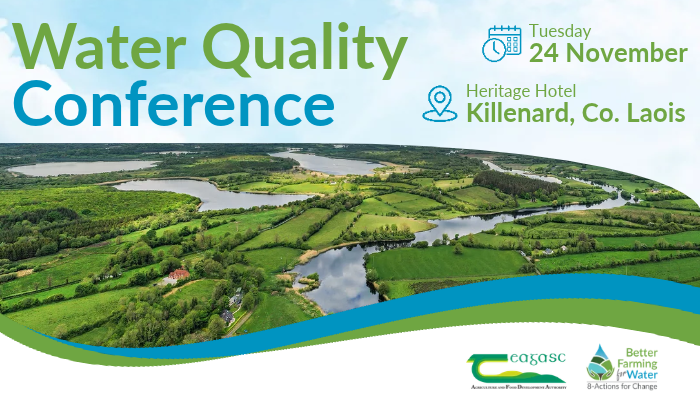
With the upcoming Teagasc Water Quality Conference scheduled for Tuesday, 24 November 2026 at the Heritage Hotel in Killenard, County Laois, attention is drawn to practical measures to improve water quality on Irish farms.
Sinéad Devaney, an advisor with the Agricultural Support and Sustainability Advisory Programme (ASSAP), plays a vital role in working directly with farmers across County Galway. Through on-farm consultations, she identifies potential issues affecting local river water quality and collaborates with farmers to implement effective solutions.
Funding is a crucial element, with Devaney assisting farmers in applying for the Farming for Water European Innovation Partnership (EIP) grant-aid. This grant, which currently is closed for applications but expected to reopen early next year, covers almost all costs of necessary measures in priority areas where water quality requires improvement. These efforts aim to secure measurable progress and potentially unlock further funding under Results-Based Schemes.
Education also forms part of Devaney’s remit, as she engages in Teagasc farm events, farm walks and Knowledge Transfer (KT) groups alongside Teagasc and private consultants. ASSAP advisors nationwide collaborate to support farmers from all enterprises in enhancing water quality.
While drinking water standards protect human health, environmental thresholds established by the EU Water Framework Directive set stricter limits to preserve sensitive aquatic ecosystems and biodiversity. EPA assessments recommend nitrate concentrations below 8 mg/l NO3 (or 1.8 mg/l as N) to maintain good river water quality. In contrast, drinking water supplies have a maximum nitrate limit of 50 mg/l NO3 (source: www.epa.ie). For more detailed catchment data, visit Catchments.ie.
The conference offers a platform for farmers, advisors, consultants, community groups, students, and other interested parties to share experiences, address challenges, and identify actionable steps towards better water protection.
The day begins with registration and refreshments, followed by a welcome from Liam Herlihy, Teagasc Chairman, and an opening address by Professor Frank O’Mara, Teagasc Director. The agenda features three sessions:
- The first session covers National Agricultural Input Programme (NAIP) inspections, common farm issues, and upgrading infrastructure to reduce nutrient loss. A dairy farmer will share insights on how improved infrastructure and good farming practices aid compliance and water quality.
- The second session focuses on strategies to reduce nitrogen losses from grassland and tillage. Presentations include recent National Farm Survey data highlighting the potential for nitrogen balance reductions across all stocking rates, emphasising every grassland dairy farmer’s role in water protection.
- The third session addresses compliance with the Habitats Directive and Water Framework Directive, including nitrates derogation granting, slurry spreading closed periods, and a case study from the Moynalty Catchment illustrating diffuse nutrient losses from slurry spreading.